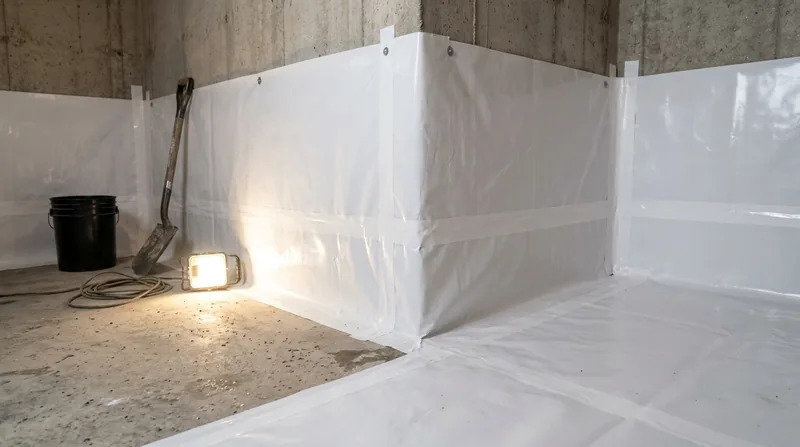




Fayetteville sits right on the Sandhills edge of the Coastal Plain, where sandy soils run over clay lenses that trap perched water above the water table. Add the heavy summer downpours, the humid summers that push moisture vapor straight through porous brick and block, and the 1920s brick Colonial Revivals on Haymount hill with their original cellars, and you get a lower level that stays damp even when no water is pooling on the floor. Vapor Barrier Installation in Fayetteville attacks that problem at the source by sealing the walls and slab against ground moisture vapor before it ever reaches your stored goods, framing, or finished space. We install heavy-duty barrier sheets with sealed seams and taped terminations, integrated with your drainage where it matters. If you already see water, start with a basement waterproofing assessment, because a barrier alone does not stop a hydrostatic problem. Call (472) 202-6252 and we will tell you plainly which one you are dealing with.
Why Vapor Barrier Installation Matters in Fayetteville's Humid, Clay-Lensed Soils
In Fayetteville, the dominant failure mode is not a single catastrophic leak but slow, steady moisture vapor driven by long humid summers and a high water table near Cross Creek. Sandy soils over clay lenses hold perched water against the foundation, and older brick in Haymount and Vanstory Hills wicks that moisture inward. Below-grade walls in Massey Hill ranches and Bonnie Doone split-levels often show efflorescence and a persistent musty smell long before a puddle appears.
- Moisture vapor moves through concrete and brick even when the wall looks dry to the touch.
- Humid summer air condenses on cool below-grade walls and slab edges, feeding that damp smell.
- Perched water on clay lenses keeps the soil against the footing saturated after every heavy rain.
- Original cellars on sloped lots in Haymount and Hillendale were never built with a modern barrier.
A properly sealed barrier cuts that vapor drive and keeps the lower level usable, but it belongs on top of working drainage, not instead of it.
Key info: A homeowner in Vanstory Hills had a dry floor but a musty smell every July. The culprit was vapor coming through the original block wall, not a leak. A sealed barrier over the wall and slab, tied to the existing perimeter drain, solved it without excavation.
North Carolina does not license home improvement contractors statewide, so verify local credentials through the state contractor resources and your city or county building department before work begins.
How We Install Vapor Barriers in Fayetteville Basements
We start by finding out where the moisture is actually coming from, because a barrier over a wall that is taking hydrostatic pressure will fail at the seams. We check the footing drain, the interior perimeter drain, and the sump basin before we cut a single sheet. Then we prep the surface, seal penetrations, and run the barrier continuously from wall to slab with taped terminations at the rim.
- We inspect the walls and slab for active seepage, efflorescence, and failed parging.
- We confirm the interior drain tile system and sump are moving water before the barrier goes down.
- We clean and prep the concrete and masonry so the adhesive and termination tape bond.
- We hang heavy-duty barrier sheets with overlapping seams and seal every seam with compatible tape.
- We integrate the barrier with the sump basin and discharge path where the layout requires it.
- We tape terminations, check the perimeter, and walk the job with you before we leave.
If the inspection turns up a crack that is actively seeping, we address it first, often with foundation crack repair, so the barrier is not hiding a moving problem.
Key info: In a 1960s split-level in Cliffdale, the slab was dry but the lower wall read damp all summer. We sealed the wall, tied the barrier into the existing sump basin, and the musty smell was gone within a week. No excavation was needed.
Vapor Barrier Approaches We Use in Fayetteville Homes
Not every basement needs the same barrier. The right approach depends on whether the wall is dry masonry, damp block, or a slab that is wicking moisture from below. We match the material and the termination detail to what the inspection finds.
| Approach | Description | Best for |
|---|---|---|
| Wall sheet barrier | Heavy-duty sheet sealed to masonry with taped seams and terminations. | Damp block or brick walls with no active seepage. |
| Slab barrier | Barrier laid over the slab with sealed laps and perimeter termination. | Slabs wicking moisture in humid summers. |
| Dimple board drainage mat | Drainage mat against the wall that channels water to the perimeter drain. | Walls with minor seepage that need a drainage path. |
| Sump-integrated barrier | Barrier tied into the sump basin and discharge line so vapor and water leave together. | Basements with an active sump and high water table. |
We will tell you when a simple wall barrier is enough and when the moisture is really a drainage problem that needs the interior drain addressed first.
Vapor Barrier Installation Cost in Fayetteville: What to Expect
Most barrier work in Fayetteville starts around $3 per square foot, and that figure moves with wall height, access, and how much prep the surface needs. A clean, dry block wall in a Hope Mills ranch is a different job from a 1920s cellar in Haymount with failing parging and tight access. We price the actual scope, not a flat rate.
- Wall height and total square footage drive the material and labor line more than anything else.
- Surface prep for efflorescence, loose parging, or old paint adds time before the barrier can bond.
- Access matters in older homes with narrow stairs, low headroom, or finished framing in the way.
- Drainage integration with the sump basin or perimeter drain adds a step but prevents trapped moisture.
Get two or three written estimates and compare scope, not just the bottom line. Our full pricing overview lays out how we build a number.
Finding a Vapor Barrier Installation Contractor Near Me in Fayetteville
Fayetteville has plenty of general handymen who will hang plastic and call it a barrier. The difference shows up a year later when the seams peel and the musty smell returns. Look for a contractor who specializes below grade, carries liability and workers' compensation insurance, and will put the scope in writing before starting.
- Ask for a certificate of insurance and confirm the coverage is current for the job dates.
- Get at least three estimates and compare what each one includes for prep, seams, and terminations.
- Check references from similar homes, especially older brick or block basements in Haymount or Massey Hill.
- Confirm permit needs with the local building department, since rules vary and drainage alterations can trigger review.
We are a Basement Health Association member and we walk every job before quoting it. Reach out through our contact page to schedule a free inspection.
Key info: A homeowner in Stedman got three quotes, and the cheapest one skipped seam tape entirely. The barrier failed at the first humid stretch. The written scope is what separates a real barrier from a plastic sheet.
Vapor Barrier Installation in Fayetteville: Pricing Guide
| Service | Price | Details |
|---|---|---|
| Wall sheet barrier | Starting at $3/sq ft | Includes surface prep, heavy-duty sheet, sealed seams, and taped terminations. |
| Slab barrier | Starting at $3/sq ft | Includes slab prep, sealed laps, and perimeter termination at the wall. |
| Dimple board drainage mat | Starting at $4/sq ft | Includes drainage mat against the wall tied to the perimeter drain. |
| Sump-integrated barrier | On estimate | Needs an on-site look to tie the barrier into the basin and discharge. |
| Travel | Included | in Fayetteville and surrounding areas, no separate call-out or mileage fee |
| Estimate | Free | Response within 24h at (472) 202-6252, no obligation to book |
Indicative pricing, the exact cost depends on square footage, finish, and site access. Free personalized estimate within 24h at (472) 202-6252.


