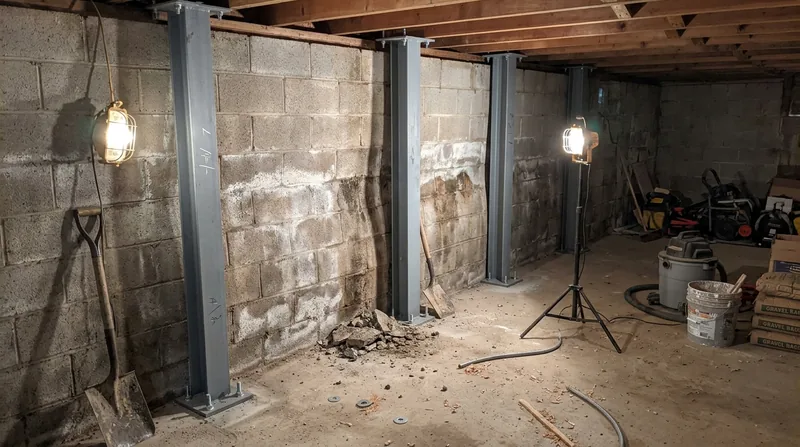




A Bowing Wall Repair in Fayetteville is not a cosmetic fix. When a block or poured wall starts to lean inward, the soil behind it is pushing harder than the wall can resist, and that movement does not stop on its own. Fayetteville sits on the Sandhills edge of the Coastal Plain along the Cape Fear River, where sandy soils with clay lenses trap perched water and the water table near Cross Creek stays high through long humid summers. The older brick Colonials on Haymount hill, the 1950s ranches and split-levels in Massey Hill and Bonnie Doone, and the walk-out lower levels in Kings Grant and Gates Four all sit on lots that collect that pressure. We diagnose the cause, match the repair to the severity of the movement, and stabilize the wall before it gets worse. Call (472) 202-6252 for a free basement inspection, or start with our foundation crack repair page if you are still sorting out what you are looking at.
Why Bowing Walls Show Up in Fayetteville's Older Basements
The dominant failure mode here is saturated soil pressing on block walls after long rainy stretches. Fayetteville takes heavy summer downpours, and hurricanes like Matthew in 2016 and Florence in 2018 pushed the creeks and the Cape Fear over their banks. That water soaks the sandy fill and the clay lenses behind a wall, and hydrostatic pressure builds until the wall bows inward. You see it first as a horizontal crack at mid-height, then as efflorescence, then as a wall that is visibly out of plumb.
- Horizontal cracks in the middle third of a block wall usually mean the wall is bowing, not settling.
- Stair-step cracking at the corners points to differential movement and often accompanies the bow.
- White efflorescence and a musty basement smell tell you water is moving through the wall.
- Doors and windows that stick on the lower level can signal the wall has moved enough to distort the frame.
- Longleaf and loblolly pines close to the foundation pull moisture and add root pressure on sloped lots.
If you see any two of those signs together, get the wall looked at before the next rainy season. Structural foundation repair in North Carolina commonly requires a permit, and thresholds vary by jurisdiction, so verify the current rules with the North Carolina state government portal and the Fayetteville building department before work begins.
Key info: A 1930s brick Colonial on Haymount hill with a partial basement on a sloped lot is the classic case. The uphill side takes the water, the block wall bows, and the downhill side stays dry. Fixing the crack without addressing the pressure is wasted money.
How We Stabilize a Bowing Wall in Fayetteville
We start by finding out how far the wall has moved and what is driving it. A bowing wall is a structural problem, but it is usually a water problem first, so the repair has to address both. We measure the deflection, check the soil and drainage on the uphill side, and then recommend the least invasive method that will actually hold. In many Fayetteville basements the answer is carbon fiber straps or wall anchors rather than exterior excavation.
- We inspect the wall, the footing, and the drainage on the uphill side to confirm the cause.
- We measure the horizontal deflection and record it so the repair can be tracked over time.
- We recommend carbon fiber straps for moderate movement or steel I-beams and wall anchors for severe bowing.
- We install the system and torque or bond it to the footing and the floor system as the method requires.
- We correct the water source with grading, downspout extensions, and an interior drain tile system where needed.
- We re-measure and document the wall so you have a baseline for the future.
If the water is the bigger problem, we point you to our interior drain tile system page, because a dry wall stays put.
Key info: A split-level in Massey Hill had a block wall bowing about 2 inches after Florence. We installed carbon fiber straps, extended the downspouts, and added an interior perimeter drain. Two years later the wall had not moved. That is the outcome we aim for.
Repair Methods We Use and When Each One Fits
No single method fits every wall. The right choice depends on how far the wall has moved, whether it is block or poured concrete, and how much hydrostatic pressure the soil is putting on it. We match the method to the severity, and we tell you plainly when a simpler repair will do.
| Approach | Description | Best for |
|---|---|---|
| Carbon fiber straps | Straps bonded to the wall from the footing to the floor system to stop further inward movement. | Moderate bowing up to about 2 inches on block walls. |
| Steel I-beams | Vertical beams anchored to the footing and the floor to brace the wall. | Severe bowing or walls that have moved more than 2 inches. |
| Wall anchors | Anchors driven into stable soil outside and connected through the wall to plates inside. | Walls with room outside and movement that can be pulled back. |
| Epoxy or polyurethane injection | Injection ports seal the crack itself, not the movement. | Non-structural cracks that are leaking, paired with a stabilization repair. |
We will tell you when injection alone is enough and when the wall needs real structural bracing.
Bowing Wall Repair Cost in Fayetteville: What to Expect
Most bowing wall repairs here start around $600 for a focused crack injection or a small stabilization, and the price climbs from there with the length of the wall, the number of straps or beams, and how much excavation the anchors require. A full wall with steel I-beams on a walk-out lower level in Kings Grant will land well above that starting figure. Access matters too: a wall behind a finished basement or tight against a fence line takes more labor.
Get two or three estimates and compare the method, not just the number. A low bid that only seals the crack without bracing the wall is not doing the same job. Our pricing overview lays out the ranges so you can read each estimate with context.
How to Choose a Bowing Wall Repair Contractor Near Me in Fayetteville
This is structural work, so the contractor matters as much as the method. Ask for proof of licensing and insurance, and get a certificate of insurance sent to you directly. Check references from jobs in Fayetteville and the surrounding towns, and ask whether the company specializes in below-grade work or treats it as a side job. Understand who pulls the permit, and confirm the scope in writing before anyone starts.
We are a Basement Health Association member and we work below grade every day. Reach out through our contact page to schedule a free inspection, or call (472) 202-6252. We serve Fayetteville and the nearby towns, including Hope Mills, Spring Lake, and Eastover.
Bowing Wall Repair in Fayetteville: Pricing Guide
| Service | Price | Details |
|---|---|---|
| Crack injection (epoxy or polyurethane) | Starting at $600 | Seals a leaking non-structural crack; price moves with crack length and number of injection ports. |
| Carbon fiber strap installation | Starting at $1,200 | Straps bonded from footing to floor; price moves with wall length and number of straps. |
| Steel I-beam bracing | Starting at $2,500 | Vertical beams anchored to footing and floor; price moves with wall height and beam count. |
| Wall anchor system | On estimate | Requires excavation outside and stable soil; an on-site look sets the anchor count and depth. |
| Travel | Included | In Fayetteville and surrounding areas, no separate call-out or mileage fee. |
| Estimate | Free | Response within 24h at (472) 202-6252, no obligation to book. |
Indicative pricing, the exact cost depends on square footage, finish, and site access. Free personalized estimate within 24h at (472) 202-6252.


