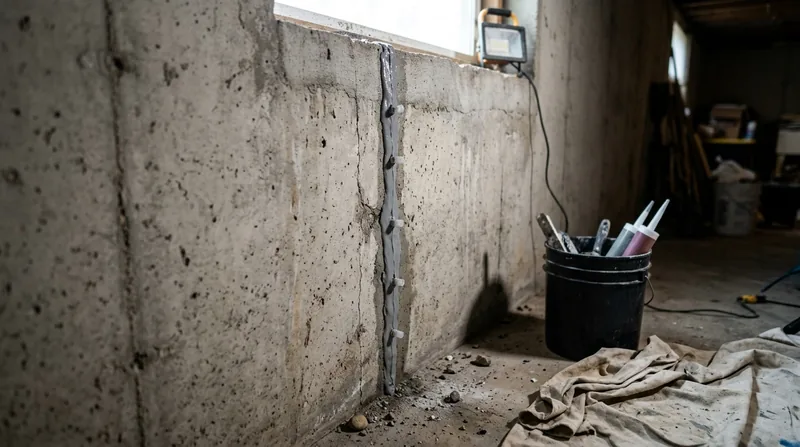




Foundation Crack Repair in Fayetteville: Below-Grade Repair for Sandhills Homes
When you search for Foundation Crack Repair in Fayetteville, you are usually standing in a basement looking at a hairline crack that has been weeping after every summer downpour. Fayetteville sits on the Sandhills edge of the Coastal Plain along the Cape Fear River, where sandy soils with clay lenses trap perched water against foundation walls. Add a high water table near Cross Creek and the mill-pond lakes, and the brick Colonials on Haymount hill, the 1950s ranches in Massey Hill, and the walk-out lower levels in Kings Grant all face the same pressure. We inspect every crack, identify whether it is shrinkage, settling, or hydrostatic pressure, and match it to the right repair method. If water is already reaching the floor, start with a full basement waterproofing assessment before sealing anything.
Why Foundation Cracks Open Up in Fayetteville's Clay-Lens Soils
Most cracks we see in Fayetteville are not random. The clay lenses under Bonnie Doone and Cliffdale hold water long after the rain stops, and that perched water pushes against the wall as hydrostatic pressure. Long humid summers keep the soil expanding, and the mild winters still bring enough wet-dry cycling to work hairline cracks wider over time. Older brick and block walls on sloped lots near the Cape Fear tend to show it first as efflorescence and horizontal seepage lines.
- Vertical cracks in poured walls usually come from concrete shrinkage and are good candidates for epoxy injection.
- Stair-step cracks in brick or block point to settling fill and need structural review, not just sealing.
- Horizontal cracks low on the wall signal bowing pressure from saturated soil pushing inward.
- White powder (efflorescence) on the wall means water is moving through the concrete and evaporating on the face.
- Cracks that only weep after heavy rain are pressure-driven and often need drainage, not just injection.
Sealing a pressure-driven crack without addressing the water behind it just moves the problem to the next weak point in the wall.
Key info: A 1920s brick Colonial on Haymount hill with a stair-step crack near the corner is a structural question, not a sealing job. A 1990s vinyl-sided home in Hope Mills with one vertical hairline crack is usually a straightforward injection. Same city, same rain, very different repair.
For official guidance on when structural repair permits apply, check the City of Fayetteville building department before work begins on any load-bearing wall.
How We Diagnose and Repair Cracks in Fayetteville Basements
We do not quote a crack repair from a photo. The first step is a free basement inspection that maps the crack, checks for moisture behind the wall, and reads the grading and downspout discharge outside. On sandy lots in Stedman and Wade, water often enters at the cove joint rather than through the crack itself, and that changes the whole recommendation. We test, we measure, and then we explain the options in plain terms.
- We walk the interior wall and mark the full length of every crack, including the part hidden behind parging.
- We check the exterior grade, downspout extensions, and any window wells to see where water is loading the wall.
- We identify the crack type: shrinkage, settling, or hydrostatic pressure from saturated clay.
- We recommend injection for non-structural cracks, or structural repair for wide, offset, or horizontal cracks.
- We set injection ports, seal the surface, and inject epoxy or polyurethane under controlled pressure.
- We verify the fill, trim the ports, and patch the wall face so the repair blends in.
If the inspection shows water collecting at the footing, we may recommend an interior drain tile system alongside the crack repair, because injection alone will not relieve pressure from a saturated clay lens.
Key info: On a split-level in Massey Hill, we found a vertical crack that had been patched twice with hydraulic cement. The patch kept failing because the clay lens behind the wall stayed saturated. We injected the crack with polyurethane and added a short interior perimeter drain at the low corner. It has stayed dry through two hurricane seasons.
Repair Methods We Use and When Each One Fits
Not every crack gets the same treatment. The table below shows the methods we use in Fayetteville and the conditions that call for each one. We choose based on crack width, movement, water pressure, and wall material, not on what is easiest to sell.
| Approach | Description | Best for |
|---|---|---|
| Epoxy injection | Structural epoxy bonds the crack faces back together and restores wall strength. | Non-structural vertical cracks in poured walls that are not actively leaking. |
| Polyurethane injection | Flexible foam expands into the crack and seals against active water. | Weeping cracks with water pressure behind them, common after summer storms. |
| Carbon fiber straps | Straps anchor the wall to the floor and resist inward bowing. | Horizontal cracks and early bowing from saturated clay pressure. |
| Wall anchors | Anchors pull the wall back toward the soil and hold it in place. | Bowing walls that have moved but are not yet failing. |
| Drainage correction | Interior perimeter drain and sump relieve pressure at the footing. | Cracks that keep returning because water is trapped behind the wall. |
We pair injection with drainage correction whenever the inspection shows the crack is a symptom rather than the cause. For walls that have moved, we move to bowing wall repair with straps or anchors before the wall loses more of its capacity.
Foundation Crack Repair Cost in Fayetteville: What to Expect
Most single-crack injections in Fayetteville start at $450, and that covers the inspection, port setup, injection, and cleanup. From there, the price moves with crack length, wall thickness, access, and whether water pressure is active. A short vertical crack in a poured wall in Gates Four is a different job from a long stair-step crack in a 1930s brick wall on Haymount hill. We publish a full pricing overview so you can see the ranges before you call.
Factors that affect the final number include how many cracks are active, whether the wall is block or poured concrete, whether structural straps or anchors are needed, and whether drainage work is required to stop the water at the source. Getting two or three estimates is smart, and any honest contractor will tell you the same. Ask each one what method they plan to use and why.
Foundation Crack Repair Near Me: How to Vet a Contractor Near Fayetteville
When you search for foundation crack repair near me, you will get a mix of waterproofing specialists, general foundation firms, and handymen. The work is below grade and it is easy to hide a shortcut behind a fresh coat of parging. Here is what to check before you sign anything.
- Confirm the company is licensed and insured, and ask for a certificate of insurance before work starts.
- Get two or three written estimates that name the repair method, not just a price.
- Ask for local references, ideally from homes with the same wall type and soil conditions as yours.
- Check whether a permit is required for structural repair, and let the contractor handle the building department filing.
- Ask how the company handles HOA rules if you live in a planned community like Gates Four or Kings Grant.
A specialist who works below grade every day will explain the difference between a crack that needs sealing and a wall that needs structural support. Reach out through our contact page to schedule a free inspection and get a straight answer.
Foundation Crack Repair in Fayetteville: Pricing Guide
| Service | Price | Details |
|---|---|---|
| Single vertical crack injection | Starting at $450 | Includes inspection, port setup, epoxy or polyurethane injection, and cleanup on one crack. |
| Multiple crack injection | Starting at $750 | Priced per crack; total moves with crack length, wall thickness, and active water pressure. |
| Structural repair (straps or anchors) | On estimate | Requires an on-site look to measure wall movement and choose strap or anchor layout. |
| Travel | Included | in Fayetteville and surrounding areas, no separate call-out or mileage fee |
| Estimate | Free | Response within 24h at (472) 202-6252, no obligation to book |
Indicative pricing, the exact cost depends on square footage, finish, and site access. Free personalized estimate within 24h at (472) 202-6252.


