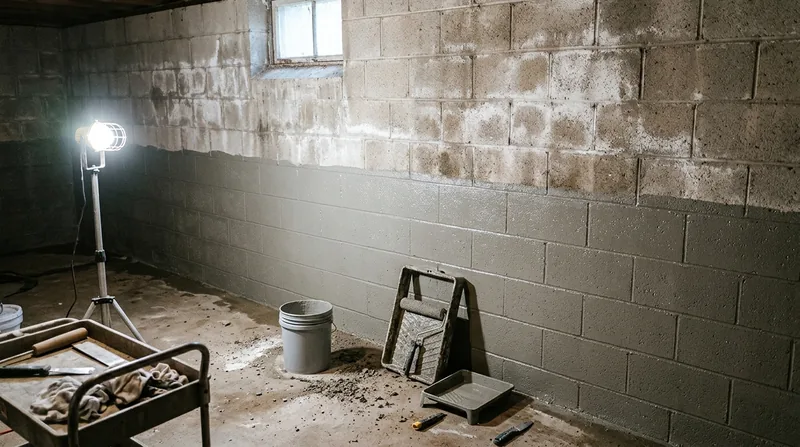




Fayetteville sits on the Sandhills edge of the Coastal Plain, and the ground under most of this city tells a split story. Sandy soils drain fast until they hit a clay lens, and then the water stacks up against the foundation like a backed-up drain. Add a high water table near Cross Creek, the Little River, and the mill-pond lakes, plus hurricane-season downpours that dump inches in hours, and basement walls here take a beating that a fresh coat of paint will never fix. Basement Wall Sealing in Fayetteville is the right answer for damp, chalky, seeping masonry, and the wrong answer for active hydrostatic pressure. We tell you which one you have before we quote anything. If your walls are wet after every summer storm in Haymount or the lower streets of Massey Hill, start with a full basement waterproofing assessment and we will separate surface dampness from a water-table problem.
Why Basement Wall Sealing Matters in Fayetteville's Older Brick and Block Basements
The 1920s to 1940s brick Colonial Revival homes on Haymount hill, the Tudor and Craftsman houses in Vanstory Hills and Hillendale, and the 1950s to 1970s brick ranches in Bonnie Doone and Cliffdale all share the same weakness: porous masonry with no modern damp-proofing on the outside face. Long humid summers drive moisture through the brick, and when it dries it leaves efflorescence, the white salt bloom that tells you water is moving through the wall. Seal the wall correctly and that cycle stops. Ignore it and the mortar joints start to soften.
- Efflorescence and chalky white staining on the lower wall means moisture is migrating through the masonry, not just condensing on it.
- Musty basement smell after a wet week in July or August usually points to damp walls feeding humidity into the space.
- Peeling paint and powdery block faces on 1980s and 1990s homes in Kings Grant and Gates Four signal a failed or never-applied sealer.
- Water after rain that appears at the wall base, not the floor seam, is a wall-seepage pattern that sealing can address.
- Standing water or a ring of damp at the floor-wall joint is hydrostatic pressure, and sealing alone will not hold it back.
Sorting those five patterns is the whole job. A sealer applied over an active pressure problem just traps water in the block and makes the next failure worse.
Key info: In Hope Mills and along the lower streets near the Cape Fear, we routinely find 1960s brick ranches where the wall seeps only during named storms. That pattern is surface-driven and responds well to sealing. A home in Stedman on a sloped lot with a walk-out lower level and water at the cove joint is a different diagnosis entirely.
For the regulatory side, foundation and drainage work in this region is governed locally, and the City of Fayetteville's permit and inspections information is the authority to check before any structural or drainage alteration: City of Fayetteville official site. Rules vary by jurisdiction and must be verified for your address.
How We Seal Basement Walls in Fayetteville, Step by Step
Sealing is a surface and substrate job before it is a coating job. We start by reading the wall: tapping block for delamination, checking mortar joints for previous patches, and testing moisture at three heights. Only then do we choose a penetrating sealer for damp masonry or a flexible membrane for walls that need a bridge over hairline cracking. The order below is the order we work in, and we stop and re-diagnose if the wall tells us sealing is not the fix.
- We inspect the wall and the floor-wall joint and note where water actually enters, not where the stain is worst.
- We remove efflorescence, old paint, and loose parging with wire brushes and a masonry-safe wash, then let the wall dry to a stable reading.
- We fill open mortar joints and non-structural cracks with a hydraulic or epoxy-based patch before any sealer goes on.
- We apply the penetrating sealer or the membrane in the specified number of coats, keeping the floor-wall joint clear for inspection.
- We check the exterior grade and downspout extension so the wall is not being re-wetted from the surface.
- We leave you a written note on what was sealed, what was monitored, and what would trigger a different repair.
A wall that fails the moisture test does not get sealed. It gets a proper diagnosis, and often an interior drain tile system is the honest answer instead.
Key info: On a 1950s split-level in Massey Hill, the lower-level wall showed efflorescence only on the uphill side. Sealing that face plus extending two downspouts four feet past the foundation solved it. The downhill wall needed nothing, and we did not sell it anything.
Sealing Approaches We Use on Fayetteville Basement Walls
Not every wall wants the same product. Poured concrete, brick, and concrete block behave differently, and a wall with active seepage at the joint needs a different treatment than a dry wall with surface dampness. The table below maps the approach to the condition we actually find in this city.
| Approach | Description | Best for |
|---|---|---|
| Penetrating sealer | A breathable silicate-based sealer that reacts inside the masonry pores and blocks liquid water while letting vapor escape. | Damp brick and block walls with efflorescence but no standing water. |
| Flexible membrane coating | A trowel or spray-applied waterproof membrane that bridges hairline cracks and resists hydrostatic pressure at the surface. | Poured concrete walls with fine cracking and intermittent seepage. |
| Crack injection plus sealing | Polyurethane or epoxy injection through ports into the crack, followed by surface sealing of the surrounding wall. | Walls with a defined crack that leaks during rain. |
| Parging repair and reseal | Replacement of failed parging with a bonded mortar coat, then a sealer over the cured surface. | Older brick basements in Haymount and Hillendale with spalling surface coats. |
| Drainage-first recommendation | We decline to seal and recommend interior perimeter drainage and a sump instead. | Walls with water at the floor-wall joint and rising hydrostatic pressure. |
Basement Wall Sealing Cost in Fayetteville: What to Expect
Most residential wall sealing jobs in this market start at From $1,500, and that figure covers a straightforward single-wall or partial-perimeter job with normal surface prep. The number moves with wall area, how much efflorescence and failed parging has to come off, whether cracks need injection first, and access. A finished basement with shelving and paneling against the wall takes longer to work around than a bare 1950s ranch in Bonnie Doone.
Brick walls in the older Haymount and Vanstory Hills homes usually land higher than poured walls because the mortar joints need repointing before sealing. Homes in Hope Mills and Spring Lake with walk-out lower levels often have more wall exposed above grade, which changes the square footage. None of that is guesswork on site, but it is guesswork over the phone, which is why we look before we quote.
Get two or three written estimates and compare what is actually included: surface prep, crack treatment, number of coats, and whether exterior grade correction is part of the scope. The cheapest number is often the one that skips prep. Our full pricing overview lays out the ranges by scope so you can compare apples to apples.
Hiring a Basement Wall Sealing Contractor Near Me in Fayetteville
This is a small market and the difference between a good sealing job and a bad one shows up two summers later. Ask for the license and insurance certificate, not a verbal yes. Ask how the contractor decides between sealing and drainage, because anyone who seals every wall they see is selling a product, not a diagnosis. Ask for references from jobs at least two years old, and call them.
Permits matter here for structural work and for anything that alters drainage or a sump discharge connection, and the local building department has the final word on your address. If your home sits in a neighborhood with architectural or HOA requirements, check those before exterior grade changes are proposed. We are a Basement Health Association member and we put our findings in writing, including when the finding is that you do not need us.
Ready to find out which problem you actually have? Contact us for a free basement inspection and we will tell you plainly whether sealing is the fix or whether pressure is the real issue. Call (472) 202-6252 and we will schedule a look at your wall.
Basement Wall Sealing in Fayetteville: Pricing Guide
| Service | Price | Details |
|---|---|---|
| Single wall sealing, surface prep included | Starting at $1,500 | Covers one wall with efflorescence removal, joint patching, and sealer coats. |
| Partial perimeter, two to three walls | Starting at $2,400 | Adds wall area and prep time; brick with failed parging moves the number up. |
| Crack injection plus wall sealing | Starting at $2,900 | Includes polyurethane or epoxy injection ports before the sealer is applied. |
| Full perimeter, older brick basement | On estimate | Repointing and parging repair on 1920s Haymount brick needs an on-site look first. |
| Travel | Included | In Fayetteville and surrounding areas, no separate call-out or mileage fee. |
| Estimate | Free | Response within 24h at (472) 202-6252, no obligation to book. |
Indicative pricing, the exact cost depends on square footage, finish, and site access. Free personalized estimate within 24h at (472) 202-6252.


