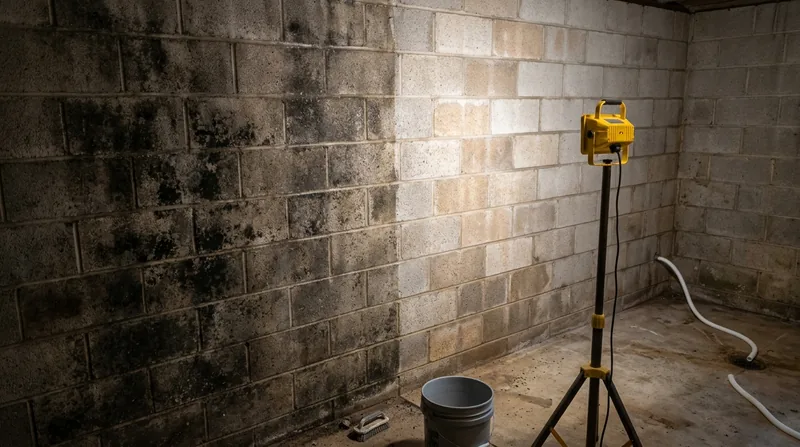




Basement mold remediation in Fayetteville starts with the water, not the bleach. Along the Sandhills edge of the Coastal Plain, the Cape Fear River, Cross Creek, and the mill-pond lakes keep the water table close to footings, and sandy soils with clay lenses trap perched water against basement walls. That means a 1950s brick ranch in Massey Hill or a walk-out lower level in Kings Grant can grow mold on a wall after one long humid summer, even without a visible puddle. We find the moisture source first, contain and treat the affected surfaces, then fix the drainage or humidity problem so the mold does not return. If you have a musty smell and no obvious leak, start with a free basement inspection so we can read the wall and the floor before anyone starts spraying.
Why Basement Mold Remediation Matters in Fayetteville's Humid, High-Water-Table Neighborhoods
Fayetteville's long humid summers and heavy downpours push moisture into below-grade rooms in a way that dry-climate cities never see. The dominant failure here is not a single cracked pipe; it is capillary rise and wall seepage after summer storms, when hydrostatic pressure builds against older brick and block foundations on Haymount hill and in Vanstory Hills. Add the hurricane seasons of Matthew in 2016 and Florence in 2018, which pushed creek and river water into low lots, and you get a housing stock where basement moisture is a recurring condition, not a one-time accident.
- Older brick Colonial Revival and Tudor homes on sloped lots often have cellars with no footing drain, so water wicks into the mortar and feeds mold on the joists and wall base.
- 1950s to 1970s split-levels in Bonnie Doone and Cliffdale have lower levels that sit below the surrounding grade, and their original drain tile is usually clogged or collapsed by now.
- Newer homes in Gates Four, Jack Britt, and Hope Mills with walk-out lower levels on lots that drop toward creeks see damp drywall and efflorescence after every heavy rain band.
- Longleaf and loblolly pine roots and dense crape myrtle plantings keep foundation soils shaded and slow to dry, which holds moisture against the wall longer.
In every one of those cases, the mold is a symptom. Treat the surface without correcting the moisture and it comes back with the next humid week.
Key info: A home on a low lot near Cross Creek in the 28301 ZIP can show mold on the lower block course within two weeks of a summer storm, while a slab-on-grade home in Stedman may never have a basement issue at all. The building stock and the lot position decide the risk, not the age of the house alone.
For the official word on local permitting and inspection requirements before any structural or drainage work, check the City of Fayetteville government site and confirm current rules with the local building department.
How We Run Basement Mold Remediation in Fayetteville, Step by Step
We do not start with a sprayer. We start with a moisture map: pin meter readings on the walls, a hygrometer reading in the room, and a look at the floor-wall joint for water staining or efflorescence. Only after we know whether the moisture is coming from wall seepage, a failed sump pump, or simply trapped humidity do we set up containment and begin remediation.
- We contain the work area with plastic sheeting and negative air pressure so spores do not spread into the rest of the house.
- We remove porous materials that cannot be cleaned, such as saturated drywall, insulation, and cardboard, and bag them for disposal.
- We HEPA-vacuum and treat the remaining surfaces with an antimicrobial product rated for basement use.
- We dry the space with commercial dehumidifiers and air movers until the wall and floor readings return to normal.
- We correct the moisture path, whether that means sealing wall seepage, repairing drain tile, or replacing a failed sump pump.
Remediation without step five is a temporary fix, and we tell homeowners that plainly before we quote the job.
Key info: A split-level in Massey Hill had mold on the lower-level paneling after a failed sump pump during a July storm. We removed the paneling, treated the block, dried the room, and replaced the pump with a battery backup sump pump so the next power outage during a downpour would not repeat the flood.
Remediation Approaches We Use in Fayetteville Basements
Not every mold job is the same scope. A small patch of surface mold on a block wall after a one-time leak is a different job from a full lower level that has been damp for years. The table below shows the approaches we use and what each one is best suited for.
| Approach | Description | Best for |
|---|---|---|
| Surface treatment and HEPA cleaning | Containment, HEPA vacuuming, and antimicrobial treatment of affected block, concrete, and joists. | Small areas of surface mold with a known and correctable moisture source. |
| Containment and material removal | Negative air pressure, removal of saturated drywall and insulation, bagging and disposal. | Larger growth areas or porous materials that cannot be cleaned in place. |
| Drying and dehumidification | Commercial dehumidifiers and air movers run until wall and floor moisture readings normalize. | Any basement that has been wet, especially in Fayetteville's long humid summers. |
| Moisture correction and drainage | Wall sealing, drain tile repair, sump pump replacement, or grading correction to stop the water path. | Recurring mold where hydrostatic pressure or a failed drainage system is the real cause. |
| Humidity control | Sized dehumidification and ventilation strategy for the finished or semi-finished lower level. | Homes with no active leak but persistent musty odor through the summer. |
We match the approach to the moisture source, not to a package price, because a surface treatment on a wall that is still taking on water is money thrown away.
Basement Mold Remediation Cost in Fayetteville: What to Expect
Most basement mold remediation jobs in Fayetteville start around $1,500, and that figure covers a contained work area, HEPA cleaning, surface treatment, and a drying cycle. From there, the number moves with square footage affected, how much porous material has to come out, and whether the moisture correction is a simple wall seal or a full drain tile and sump repair. A single damp corner in a Stedman ranch is a different scope from a finished lower level in Gates Four that has been wet for two summers.
Two things drive the price up faster than anything else: hidden growth behind finished walls, and a moisture source that was never corrected. If we open a wall and find mold on the studs, the removal and drying scope grows. If the sump pump failed and the homeowner replaced it without drying the space, we still have to dry the structure before treatment. Getting two or three estimates is smart in this market because the scope, not the hourly rate, is where the real difference shows up. Our full pricing overview lays out how we build a number.
What to Look for When Hiring Basement Mold Remediation Near Me in Fayetteville
Mold work is only as good as the moisture diagnosis behind it, so hire for the diagnosis, not just the cleanup. Ask whether the contractor is licensed and insured, and ask for a certificate of insurance before work starts. Get at least two written estimates that describe the containment plan, the removal scope, and the moisture correction, not just a lump sum. Ask for local references from homes similar to yours, especially older brick and block basements on sloped lots. Confirm who pulls any permit required for drainage or structural work, and check with the local building department because thresholds vary by jurisdiction. If your neighborhood has HOA rules about exterior drainage changes or discharge line routing, sort that out before the crew arrives.
We are a Basement Health Association (BHA) member, and we are happy to walk you through our credentials and insurance before you commit to anything. Reach out through our contact page to set up a free inspection and estimate.
One more field note: if you are comparing us to a general foundation repair firm or a plumber, ask each one whether they will correct the moisture source or only treat the mold. That question separates a real remediation plan from a cleanup that will not hold through Fayetteville's next humid summer.
Basement Mold Remediation in Fayetteville: Pricing Guide
| Service | Price | Details |
|---|---|---|
| Surface mold treatment with containment | Starting at $1,500 | Includes containment, HEPA cleaning, antimicrobial treatment, and a drying cycle for a defined area. |
| Material removal and drying | Starting at $2,800 | Adds removal of saturated drywall and insulation plus commercial drying until readings normalize. |
| Remediation plus moisture correction | On estimate | Priced after inspection because wall sealing, drain tile repair, or sump replacement changes the scope. |
| Travel | Included | In Fayetteville and surrounding areas, no separate call-out or mileage fee. |
| Estimate | Free | Response within 24h at (472) 202-6252, no obligation to book. |
Indicative pricing, the exact cost depends on square footage, finish, and site access. Free personalized estimate within 24h at (472) 202-6252.


